
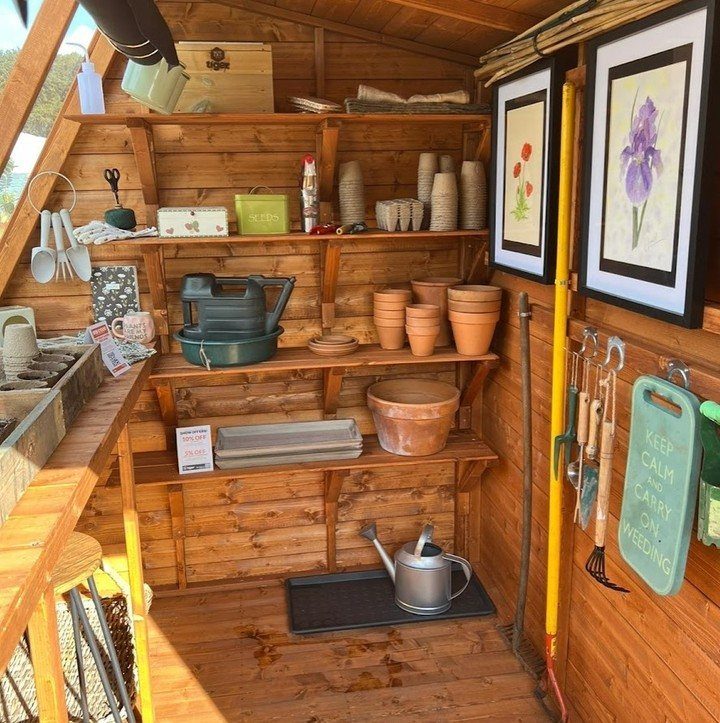
These potting shed ideas run from a wall-mounted tool rack you can hang in an afternoon to a slanted-window greenhouse shed that needs a concrete pad and a permit check before the deposit.
What decides which one belongs in your garden is whether you are starting seeds in February or just keeping soil bags off the garage floor.
The 2×4 ledger without cross-bracing that will sag by the second season under a concrete sink is the kind of detail that separates a plan you build once from one you rebuild.
1. Deep, Sturdy Shelves
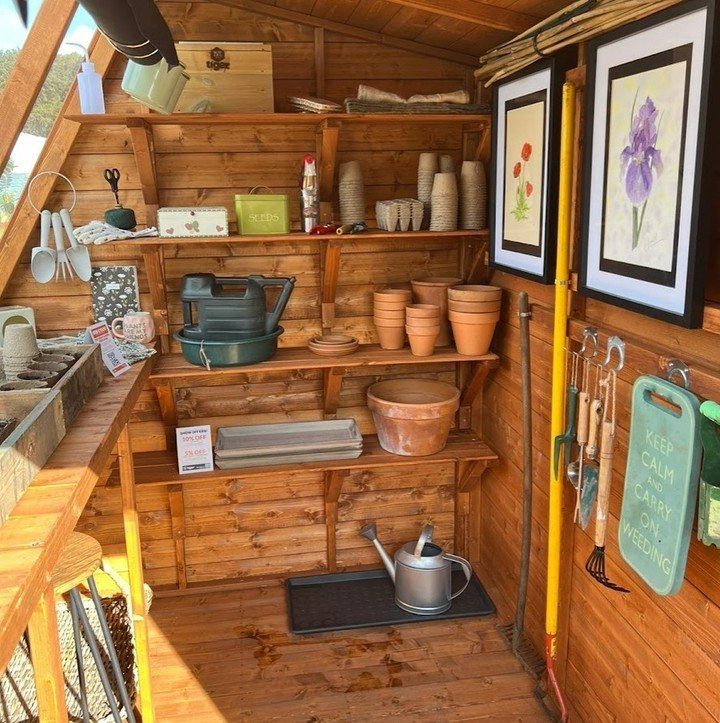
Deep shelves in a potting shed keep bags of soil upright and let you stack terracotta without the wobble that sends half of them to the floor.
What I check first is the bracket spacing: close enough that the shelf won’t bow, and I would rather use a ledger board than individual brackets if the wall studs are irregular.

Roof-Shaped Design: Elevate your plant display with our speical indoor hanging plant table

SMART, CLEAN DESIGN: Slatted shelves help shed water and dirt; tall open frame gives room for taller items (about 22" between the lower shelf and work surface) while keeping everything visible and within reach. Fits small porches and balconies yet provides generous working and storage space
2. Potting Bench
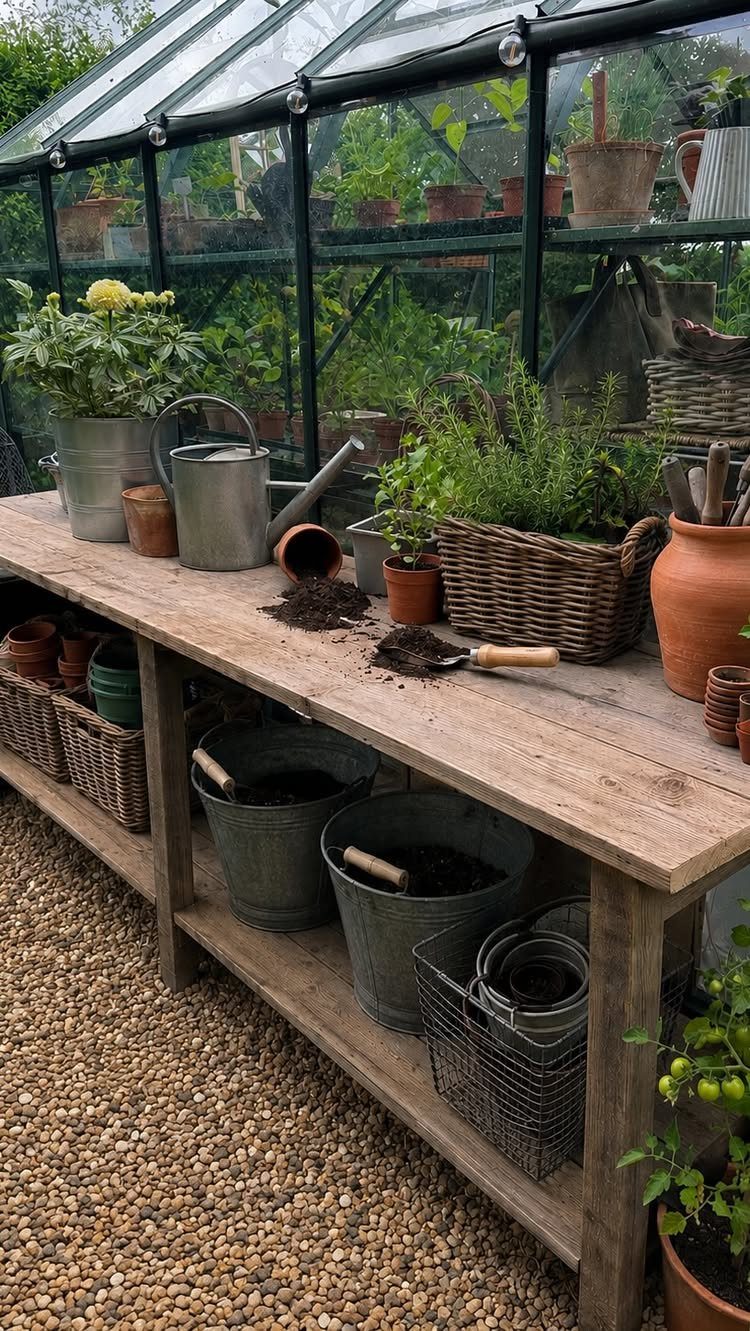
A potting bench is the one surface where I want height over storage, because bending over a low table for an hour leaves my back complaining more than the digging does.
The bench sits in a greenhouse with a gravel floor, which tells me the legs are likely pressure-treated or cedar; anything less rots where the moisture pools.
I would build to about waist height for most people, and I would add a lip at the back before I added a second shelf below.

Heavy-Duty Metal Outdoor Potting Bench:Crafted From Powder-Coated Steel, This Garden Workbench Is Built To Withstand Outdoor Elements While Holding Up To 264.55 Lb (120kg) On The Main Shelf. The Entire Unit Weighs Just 28.66 Lb (13kg) For Easy Mobility, Yet Its 41.34” W X 14.57” D X 47.24” H Frame Provides Ample Workspace. Includes A Detachable Metal Sink (20.87” L X 12.80” W X 4.21” H) With 11 Lb Hook Load-Bearing Capacity — Perfect For Mixing Soil Or Rinsing Tools Without Clutter.

Sturdy & Stable: This potting bench is crafted from high-strength, selected pure fir wood, built into a solid structure that supports up to 154 lb on the tabletop, 88 lb on the middle, and bottom shelf

UNIQUE to add a lid on the plastic sink and a extra large PVC layer on the worktable to make the potting table functional and convenient for your garden work. Covering the lid to be a whole large work table. The water will not leak into the drawer & sink by using PVC layer.
3. Pegboards and S Hooks
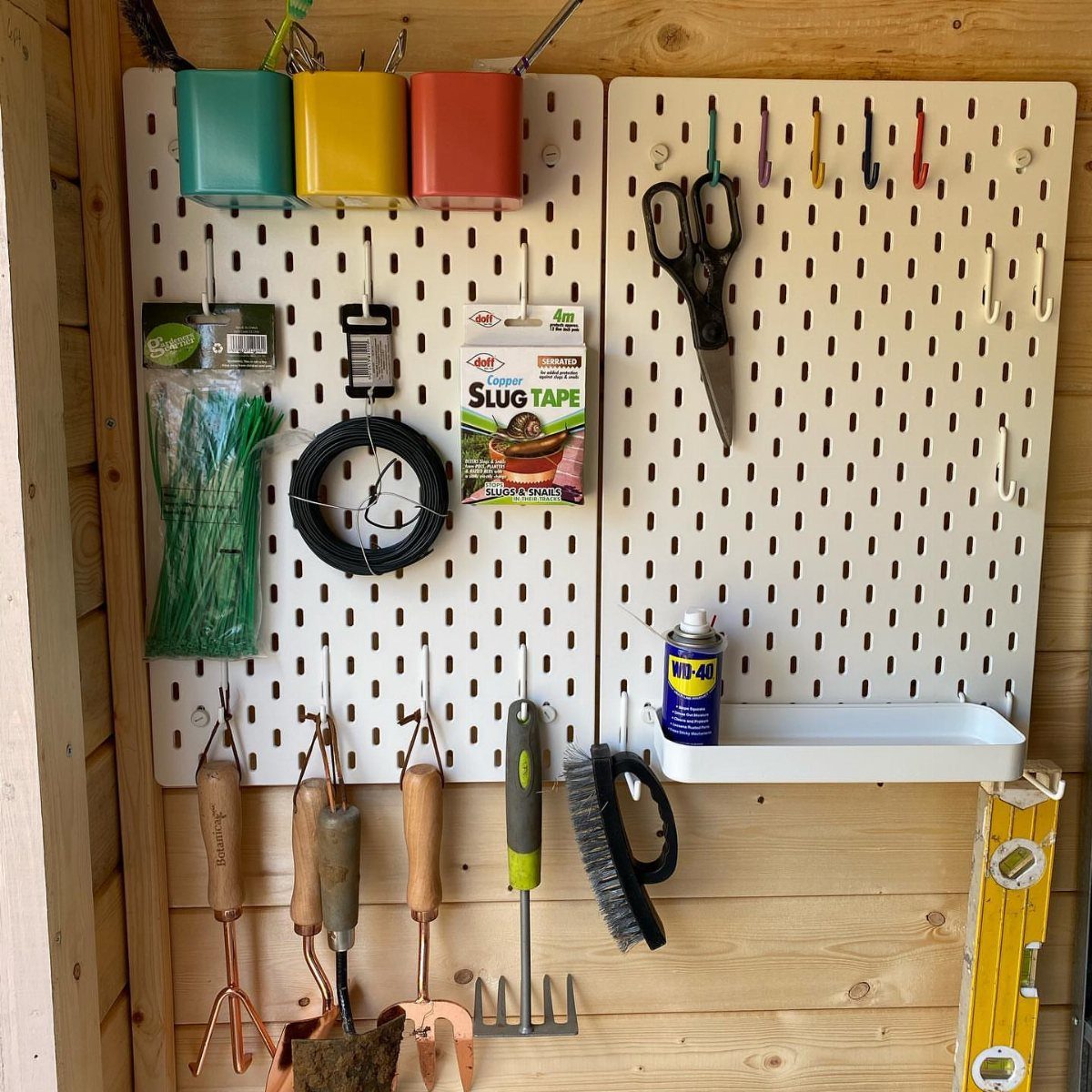
I would skip the paint on the board itself; the factory finish holds up better to the humidity swings of a shed.
The labels in the photo, "SLUG TAPE" and "WD-40," are the detail that makes this work: if I cannot see it, I will buy it again, and S hooks wander when they are not labeled.

All Metal Material: Our garden tool organizer, both backboard and hooks are made of iron, which makes it more durable and solid.And its load-bearing capacity far exceeds other usual ABS material tool hooks. It is deal for various tools like shovel, rakes, bikes, broom, mop, trust that what you get is what you see,any dissatisfaction please contact our customer service team

Value Package: Our pegboard tool organizer comes with 120pcs pegboard accessories,16 different type pegboard hooks including 5pcs pegboard bins, curved hooks, angled hooks, straight hooks, and ring tool holder, multi tool rack. 49pcs of them are peg locks for fixing hooks
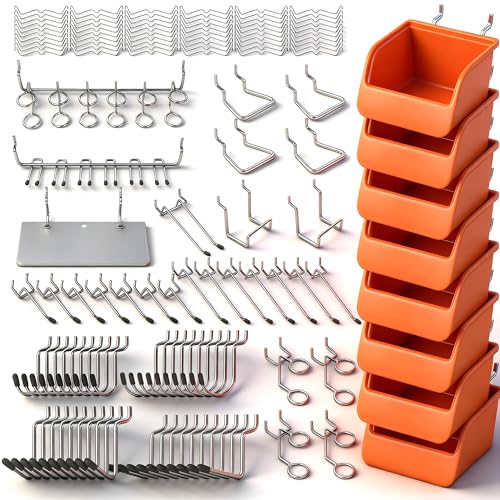
Product includes 15 different types of hooks and organizers, and is fully functional for a wide range of hanging applications.
4. Stackable Bins with Lids
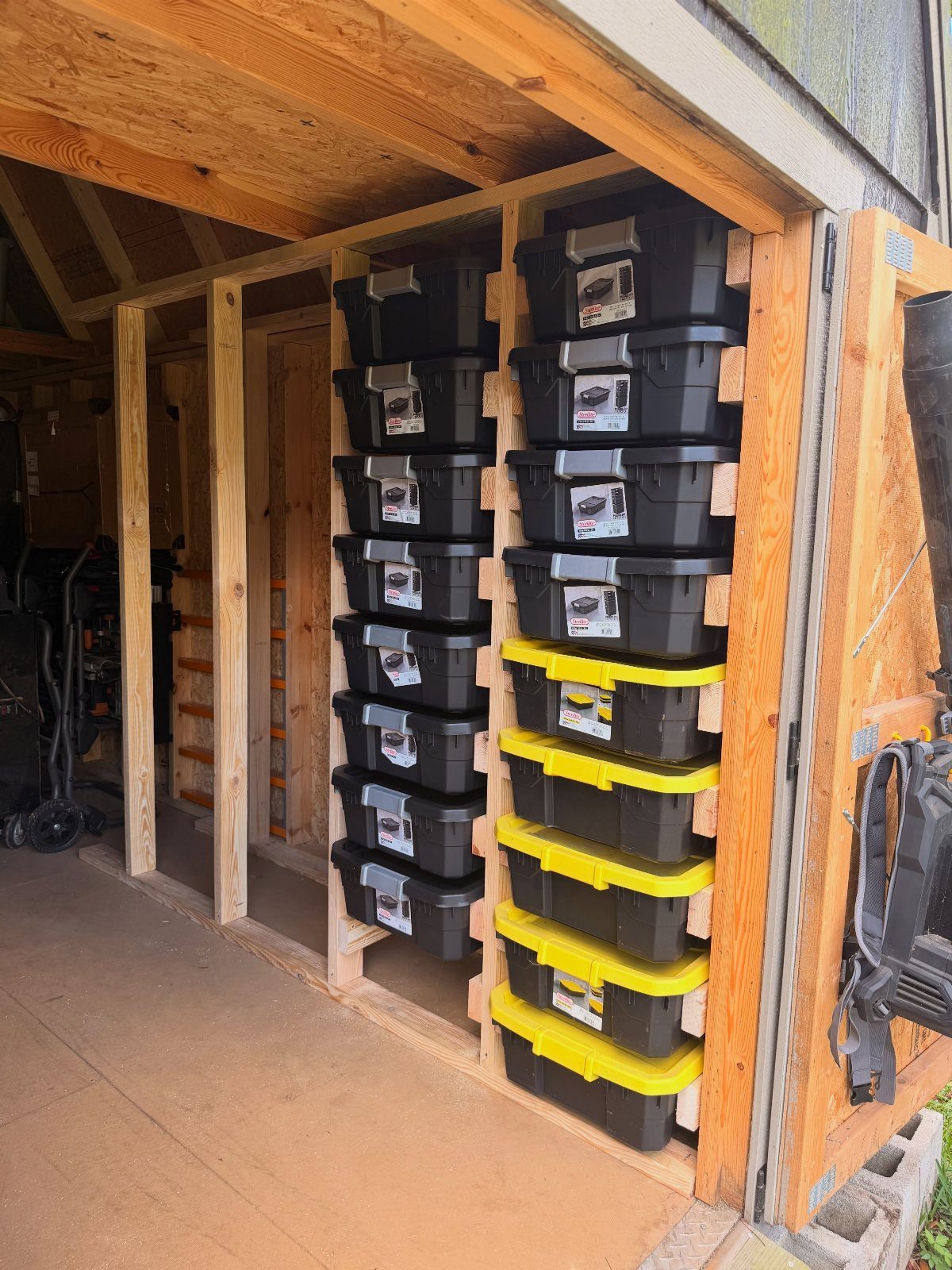
Black and yellow bins stacked two-high on built-in shelving is a color scheme that happens to look sharp, but the functional choice is the lid.
Seed packets, gloves, and hand tools stay dry and mouse-free; open bins in a shed become clutter that spiders colonize by August.
I would measure the shelf depth against the bin width before I bought anything; any overhang on each side catches knees and breaks the rim when you pull it out quick.

【High Quality and Safe】: These sturdy, long-lasting clear storage bins are made of high-quality BPA FREE material, which make these plastic storage bins keep for long-term use and safety. Dimensions:11.3x7.4x5.3 inch 7 Qt

AIRTIGHT CONTAINER: Ensure your pet's food stays fresh with airtight seals and snap-lock latches, keeping moisture and humidity out. Lock in the freshness of dry food and treats while maintaining a neat and organized food storage area.

Large Capacity & Collapsible Design: Our dog food storage container holds from 7lbs to 50lbs, switching instantly between massive storage and slim space-saver modes. Easily collapse it when empty to save space – suitable for pantries, RVs, or under-bed storage. No more single-use containers!
5. Stainless Steel Sink
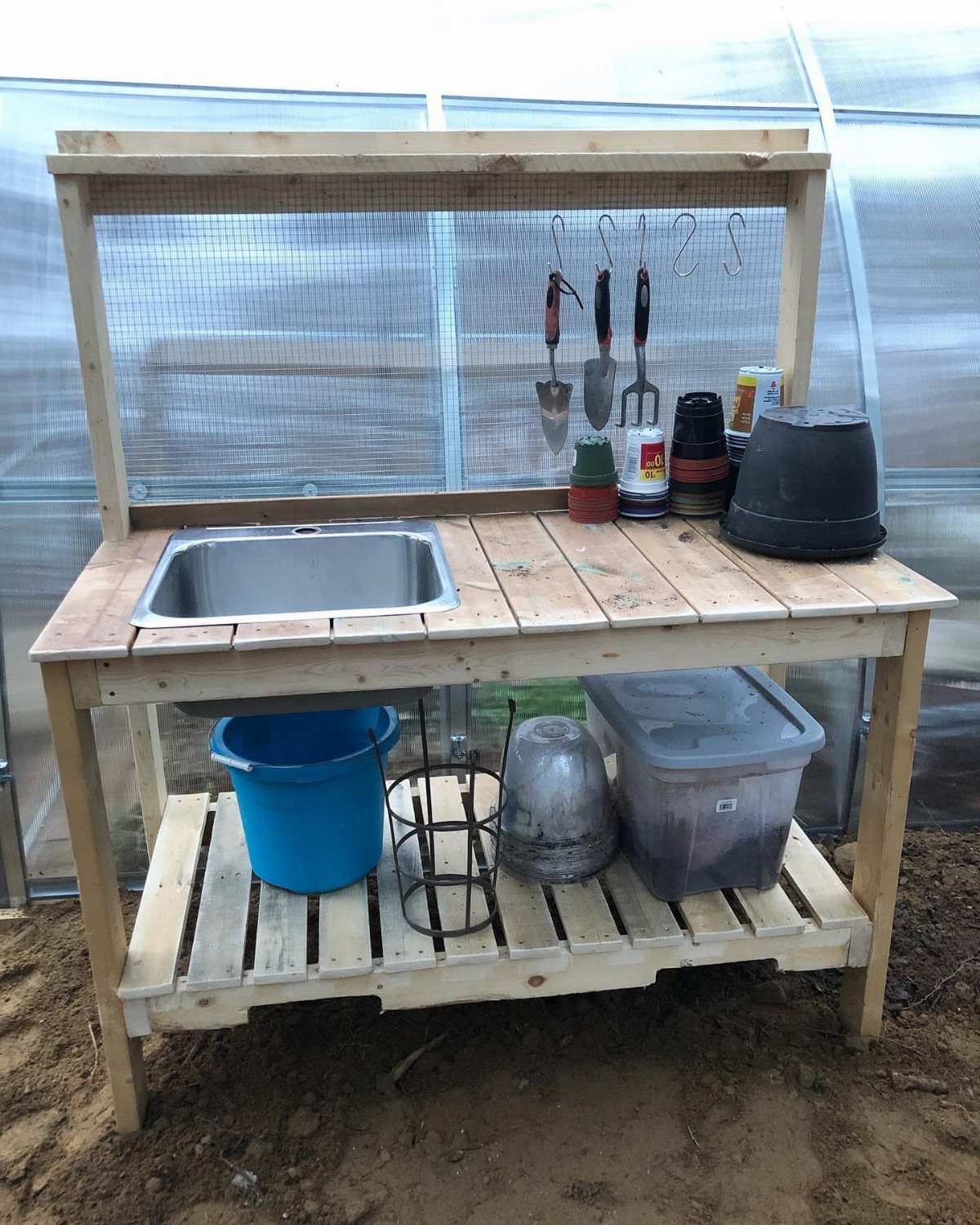
A drop-in stainless sink set into a wooden bench is the upgrade I suggest when someone asks about rinsing roots or washing hands without trekking back to the house.
The steel gauge matters less than the seal: I would bed the rim in silicone, not plumber’s putty, because the wood moves and the putty dries hard.

Sink Dimensions: 25" X 22" X 6-9/16" Min. Cabinet Size: 30"

Premium Quality: Crafted from premium 16 gauge SUS304 stainless steel, its sink body is reinforced with an extra-thick 3 mm edge. The brushed nickel finish enhances its resistance to wear, heat and corrosion

ADA COMPLIANT: Product is ADA compliant when properly installed.
6. Cozy Seating Area
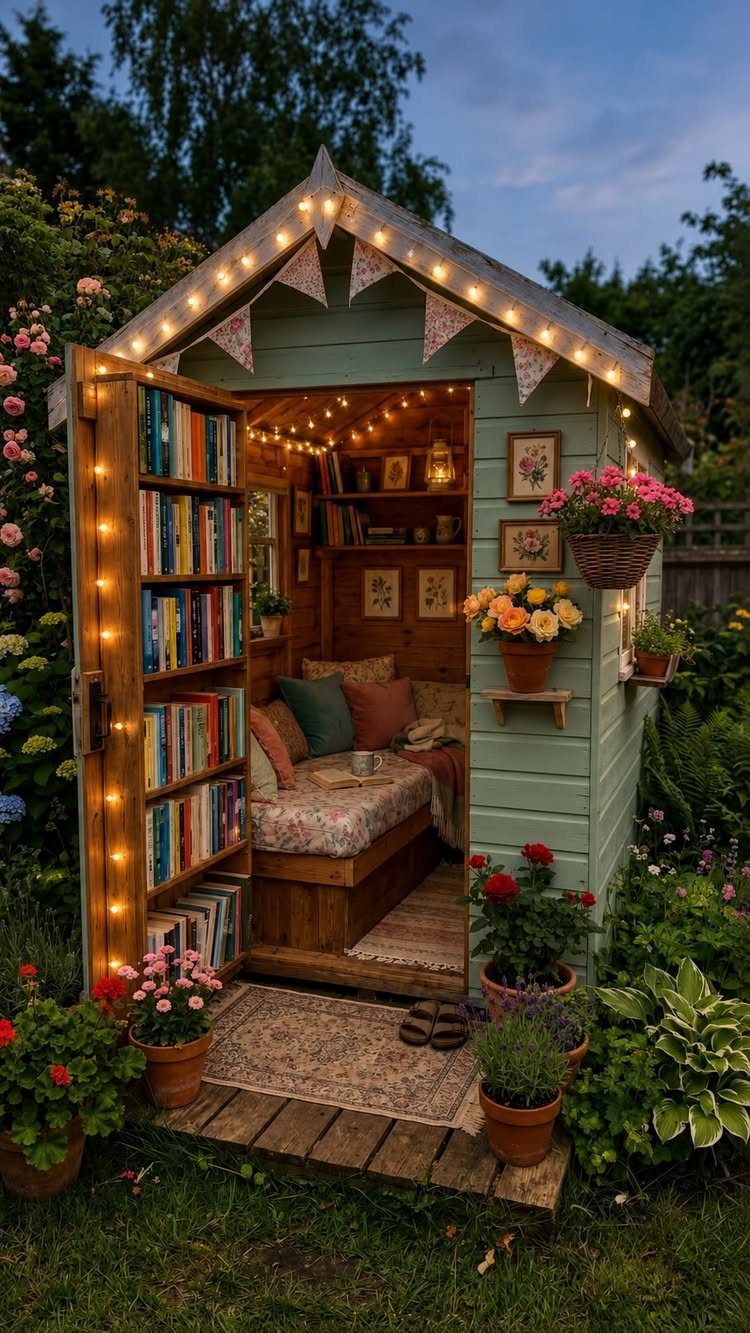
Fairy lights and a daybed in a shed is the idea I would skip unless I actually sit in my garden after dark, which I mostly do not.
What I would check before building anything permanent is whether the shed is dry year-round; cushions stored damp turn musty in 2 seasons, and the fix is not more Febreze, it is a roof vent I should have added first.

DIY More Creative Shapes -- By changing the position of the hexagons, you can create more fun unique shapes with your family. Furthermore, this hexagonal plant stand can be extended infinitely like a honeycomb by adding additional "hexagonal plant stands".

HIGH LOAD-BEARING CAPACITY - Crafted from premium-quality wood, this product offers exceptional weight-bearing performance. You can freely place more flowers and potted plants, maximizing your greenhouse's storage potential without wasting any available wall space.

Immersive Gardening Experience - This comprehensive wooden station lets kids experience the entire planting process from seed to harvest. Providing a powerful sense of accomplishment, it nurtures a deep love for nature and outdoor exploration.
7. Vintage Items
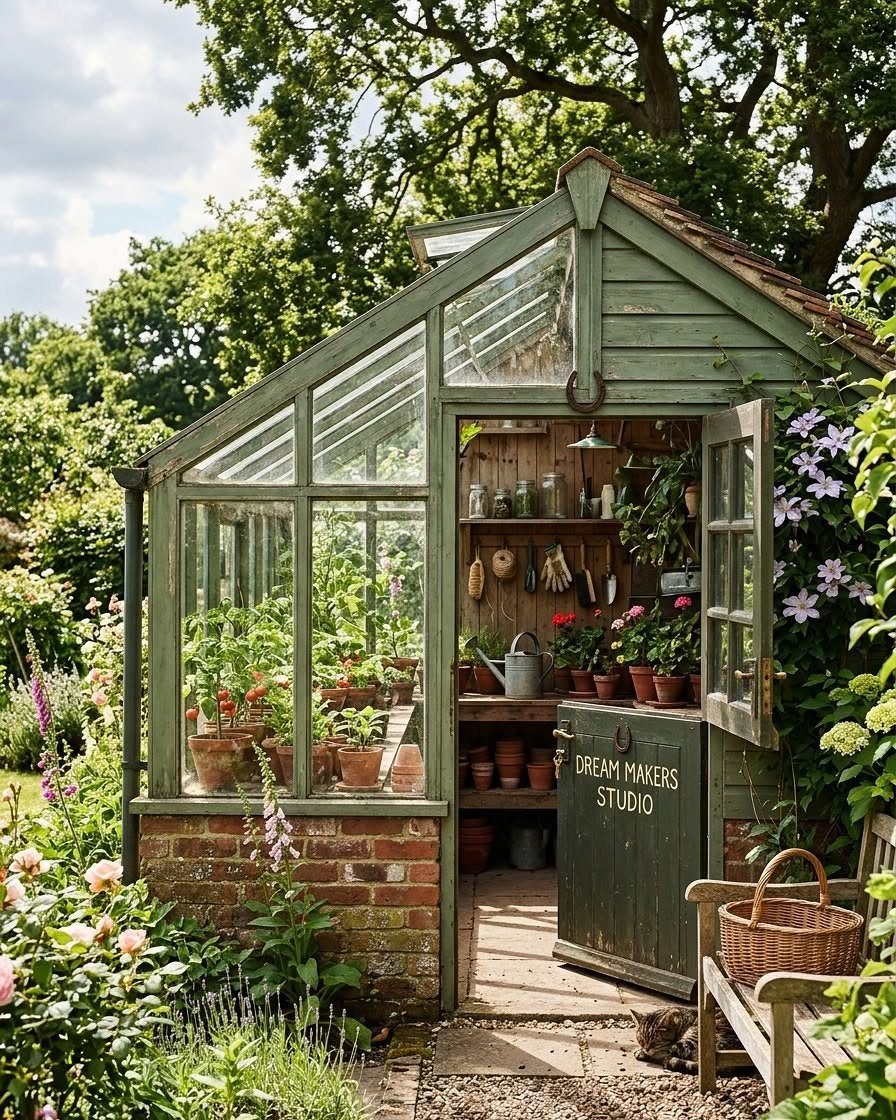
Vintage items in a potting shed work when they are already weathered, because new paint trying to look old chips faster than the real thing.
I would check that any metal is coated or galvanized; rust spreads in humid air and stains the floor where you set it down. Exterior-grade green paint, already faded, saves you from worrying over the next scratch.
I would not bring in anything I mind losing to moisture; a shed is not a house, and the cat has the right idea sleeping on the bench, not the tools.
8. Rustic Concrete Sink Setup
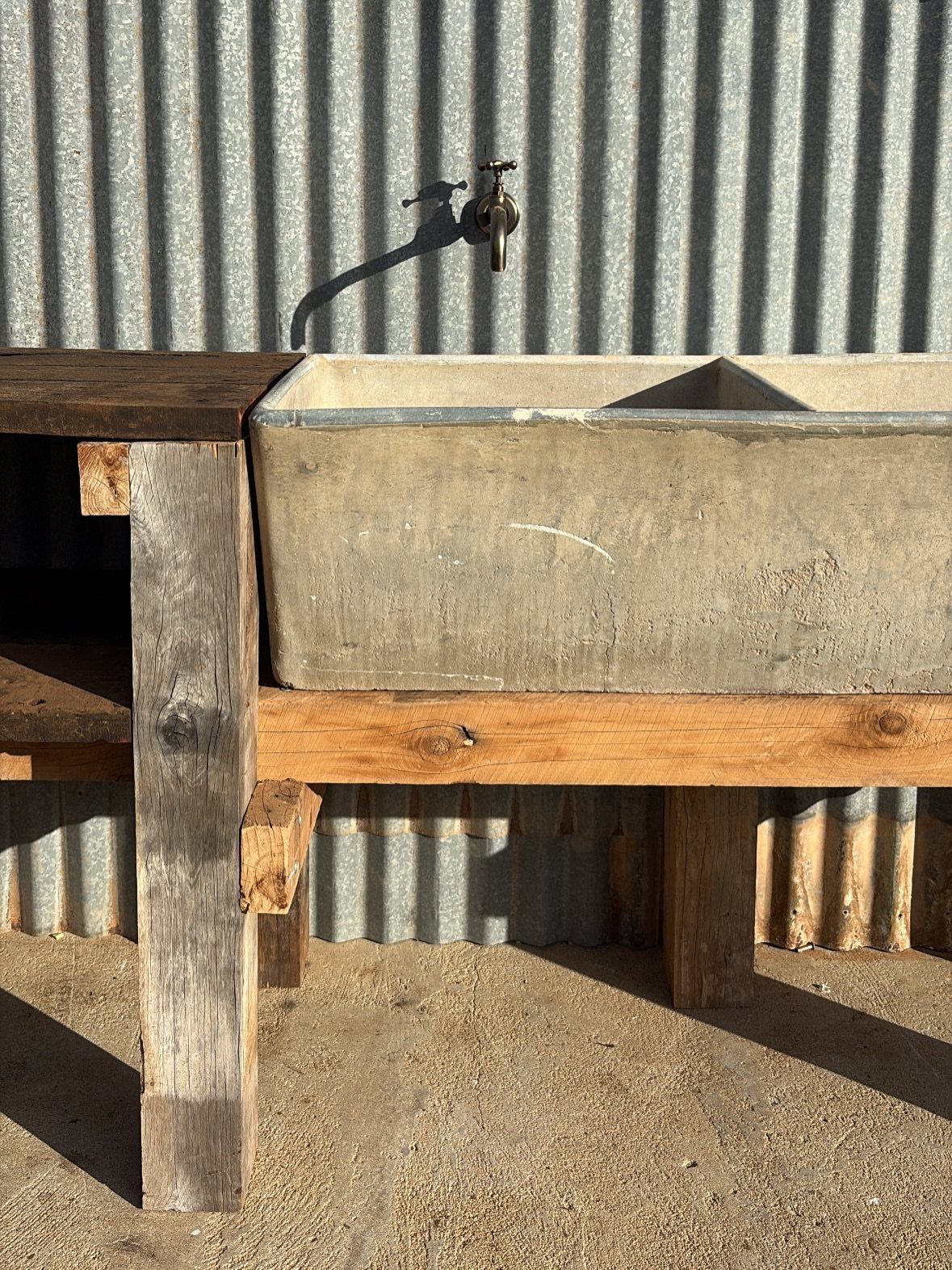
A concrete sink on a wooden bench is the setup I would build if I had a water line run to the shed and no patience for porcelain chips.
The two basins let me rinse soil off roots in one and wash hands in the other, which keeps the grit out of the drain trap.
What I would check first is the bench framing; concrete weighs more than steel, and a 2×4 ledger without cross-bracing will sag by the second season.
The corrugated metal wall behind it suggests this is a lean-to or an addition, so I would verify the roof sheds water away from the bench seam, not toward it.

Heavy Duty Construction: Each hook supports up to 30 lbs for reliable everyday storage. These heavy duty pegboard hooks are suitable for hanging hammers, cords, hand tools, and other equipment

Colorstorm Peg Hooks do not have split barbs that damage peg holes

【Hardened construction for strong strength】Galvanized l shape pegboard hook is easy to be installed and fixed without sliding or falling and can bear same pressure for longer time in comparison with other hook.Built to last years of service.Great for use in shop,locksmith shops,kitchen,office,basement,hardware stores,garage,retail stores and so on
9. Herb Drying Racks
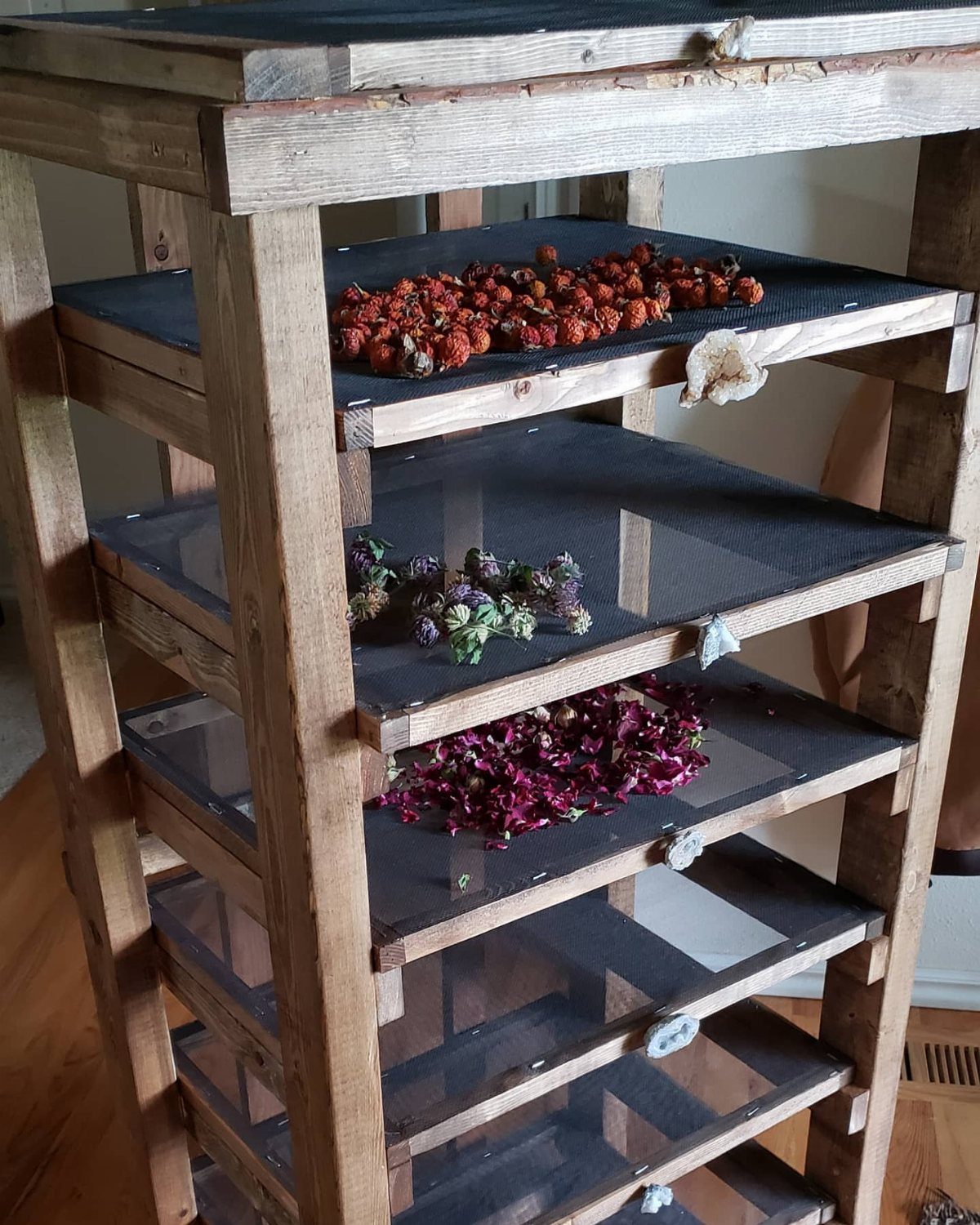
A sliding tray rack for drying herbs saves the counter space I would otherwise cover in newspaper and lose for a week.
The mesh screen matters more than the wood; air needs to pass above and below, or the bottom layer molds while the top layer crisps.
I would pull the trays out far enough to check for dust before loading them, and I would not dry anything still damp in a shed without a small fan.
Berries and blossoms that clean and dry tell me the rack lives indoors or the shed is tight enough to keep humidity steady.

VERSATILE CRAFT ORGANIZER: Stackable storage box system ideal for beads, crayons, paints, cross stitch supplies, hair accessories, and more.

What you get: you will receive 48 packs small clear plastic box bead storage box with flip cover, great small clear containers for storing and organizing

3-Tier Storage with 90 Mini Clear Boxes:This 3-tier bead organizer includes 90 mini clear boxes—30 per tier—each with its own lid. Overall case size: 【约 18× 24 × 20 cm / 9.5 × 7.1 × 7.9 in】. Each mini box: 【约 5.5 × 5.5 × 2 cm / 2.2 × 2.2 × 0.78 in】. Ideal for seed beads, glass beads, crystals, rhinestones, buttons, earring findings and other tiny items.
10. Hanging Mason Jar Herb Display
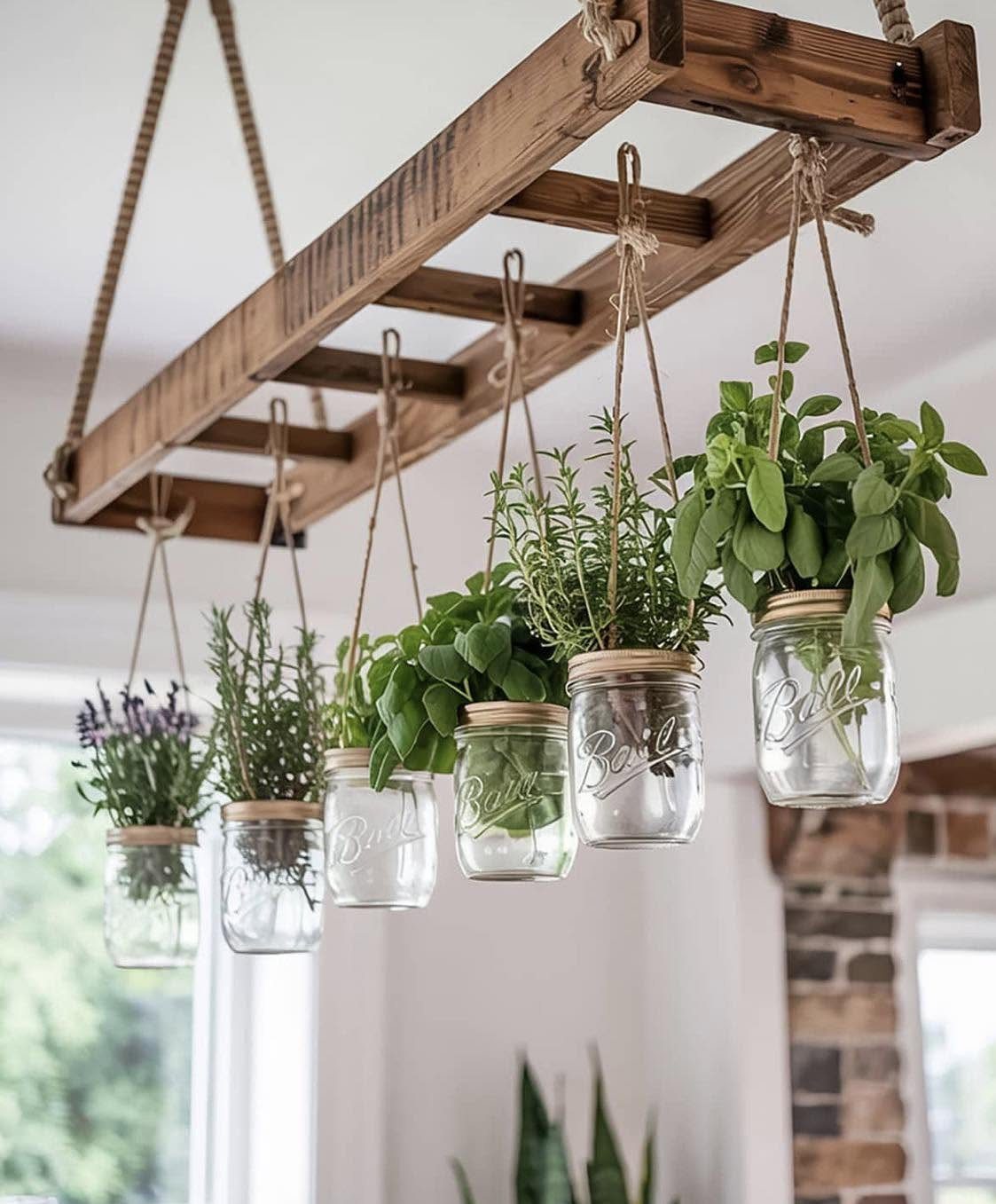
Hanging mason jars from a ladder rung is the herb display I would use in a kitchen or a sunroom, not a working potting shed; twine rots, glass breaks, and dirt falls out when you move them.
For the same look with less upkeep, I would switch to wire or chain and set the jars in rings that hold the bottom, not just the neck.
Fresh herbs need water, which means taking them down every few days, so this version suits someone who enjoys the ritual. I would keep one jar per rung; crowding blocks light and the leaves yellow where they touch.


Eco-Friendly & Wood-Like Beauty:Crafted from premium HDPE (High-Density Polystyrene), this potting bench mimics real teak grain and natural knots — without cutting a single tree. Weatherproof, rot-proof, and fade-resistant, this outdoor gardening work table stays beautiful for years, Requires no painting or sealing

Durable NSF Stainless Steel: Made of SUS201 stainless steel with brushed finish, rustproof, scratch-resistant, corrosion-resistant, easy to clean, durable, and NSF certified for food security
11. Wall-mounted Tool Racks
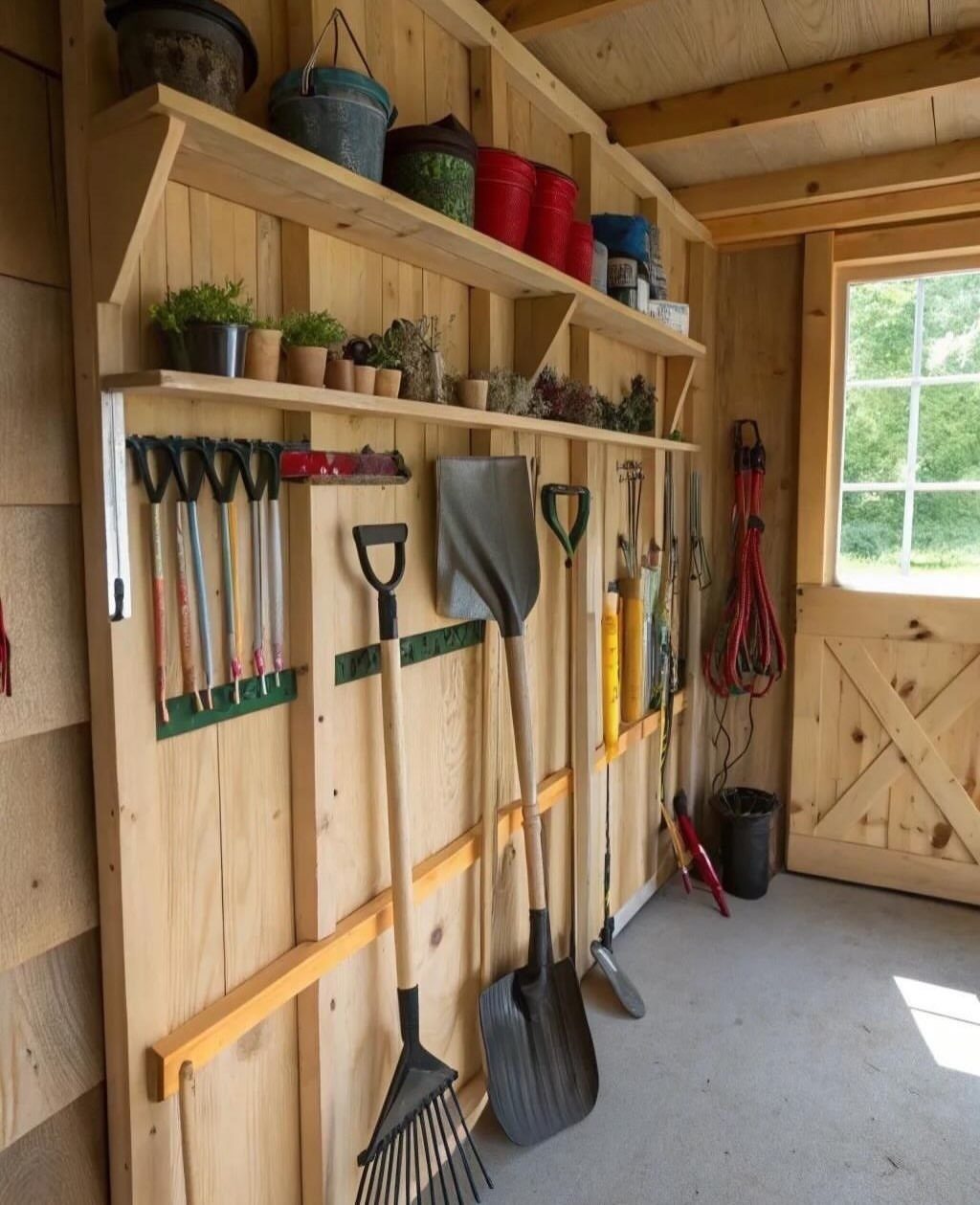
Wall-mounted racks for long-handled tools are the storage I install first in any shed, because the floor is where tripping happens and where I set pots I actually need.
Blade-up storage is what I prefer; blade-down collects mud against the wall and dulls the edge faster.
I would mount at two heights, one for rakes and hoes with the handle angled, one for short hand tools flat against the stud.
The barn door nearby tells me this shed has no room for a swing door, so I would measure the tool handles against the door path before I set any rack; a shovel handle sticking out stops the door and chips the paint.
12. Patterned Tile Flooring
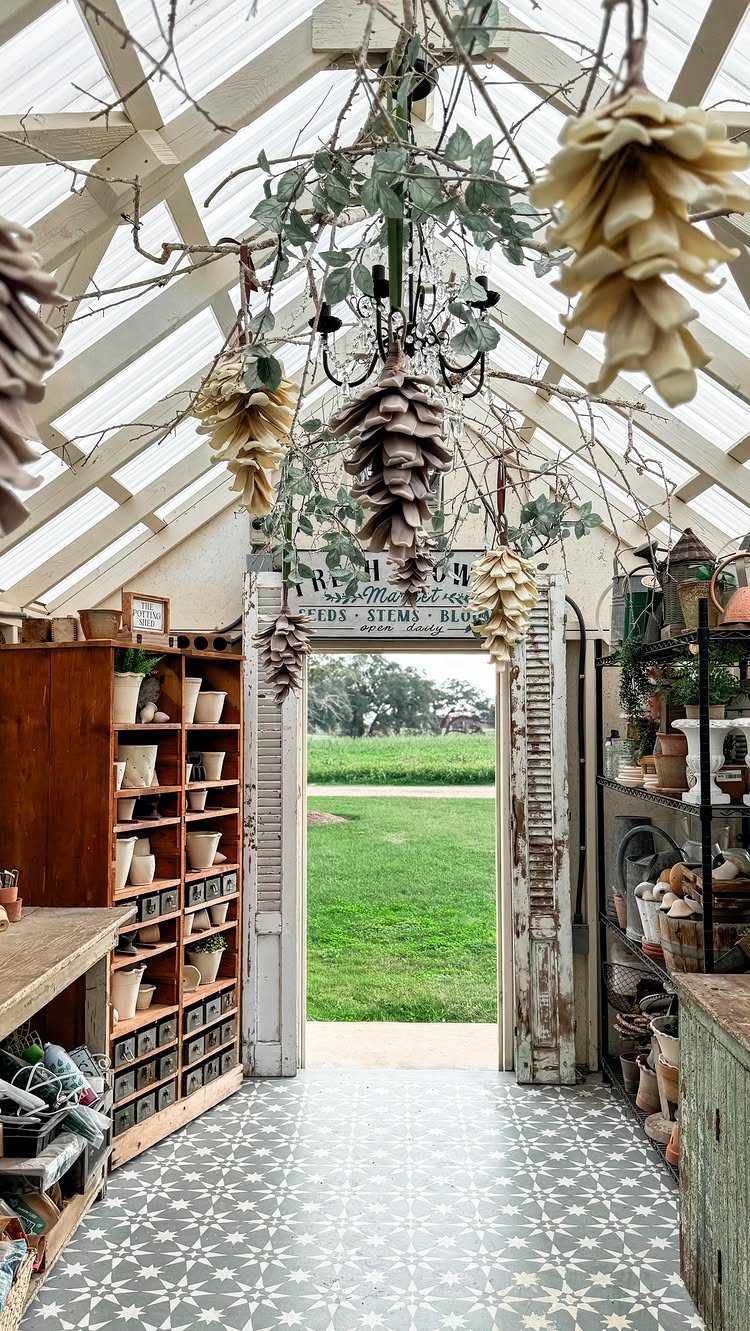
Patterned tile in a potting shed is the choice I would make only after solving every leak and drainage issue, because grout stains with soil and sealer wears where you drag pots.
The star pattern reads as a design choice, but the practical detail is the tile size; smaller tiles mean more grout lines, and more lines mean more places for grit to lodge.
I would go with a porcelain body rated for outdoor use, not ceramic, and I would keep a few extras in the loft for the inevitable crack.
The white beams and shelving above it work because they reflect light down onto the floor; in a darker shed, this tile would read as busy, not bright.
13. Slanted Window Greenhouse Shed
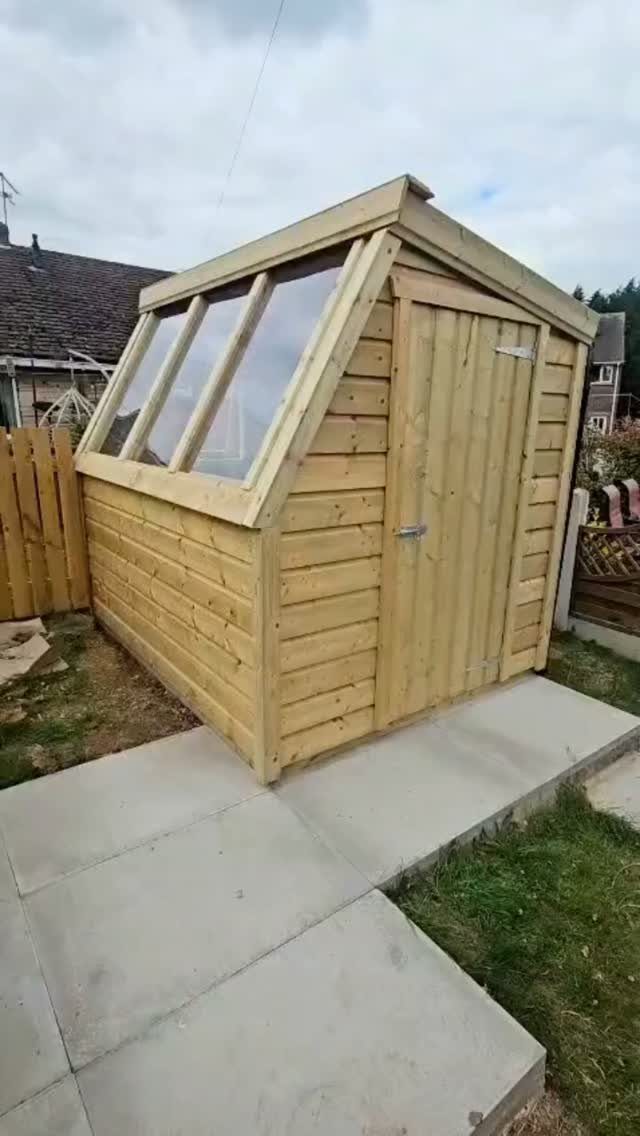
A slanted glass wall on a shed turns the whole structure into a season extender, not just storage.
The angle matters; too steep and summer heat builds too fast for seedlings, too shallow and winter light slides off without warming the soil trays inside.
I would check the sill height before building the frame; low enough to reach across from the outside, high enough that the front row of pots still catches the light.
A concrete pad does real work here; wood sills on dirt rot where splashback hits, and a level base keeps the door swinging free as the frame settles.
I would want a vent in that roof, even a small one, because glass this size turns the shed into a greenhouse by noon and cooked roots do not recover.
Choosing the Right Location
A southern exposure is what I would check first on any site, because the low winter sun matters more than the high summer sun when you are starting seeds on a bench.
Sheltering the shed from the prevailing wind cuts drafts through window gaps and keeps the door from fighting you in March.
I would walk the path from the nearest spigot with a hose in hand before I committed to the pad; if it kinks or drags across beds you will skip watering and the seedlings will show it.
Electrical rough-in is worth ordering with the shed package, since chasing conduit through finished walls later costs more and looks worse.
The permit check comes before the deposit, not after; town rules on who can touch the wiring vary by state, and a held-up inspection wastes the whole planting season.
Insulation Benefits
Insulation turns a shed from storage into a room you actually enter in February.
Temperature swings between night and day stress seedlings more than the cold itself. Trays can bolt and damp off from that swing alone, which is why insulation matters.
A small heater extends the sowing season at one end, a fan at the other, and together they justify the up-front cost in a single year if you start more than a few dozen plants.
I would not count on body heat or a sunny day; the mass of soil in trays holds cold longer than air does, and your hands will know it.
Roof Design Considerations
A gambrel roof buys headroom without buying footprint, which matters when the garden plan leaves you a narrow rectangle against the property line.
The Dutch developed it for hayloft access, and in a shed it serves the same purpose: a second level of storage you reach with a short ladder, not a full staircase.
I would ask about roof light panes or a skylight before the order is cut; the gambrel creates volume but can leave the center dim without one.
Metal roofing over shingles is the choice I would make only where I planned to collect runoff.
The gutter setup has to match; a standard residential gutter will overflow in a hard rain on a shed roof with its shorter run and steeper pitch.
If I were adding a sink, I would run the water line before the pad goes in, not after, because trenching through established paths is work you pay for twice.
Frequently Asked Questions
How to build a storage shed cheaply?
Upcycled materials and what you already own cut the real costs. I would start with wood pallets for the frame if the foundation is already in place, since pallet structures go together fast without new lumber prices.
Shopping your own house for crates, baskets, and vintage hooks saves more than thrift runs; the decorative pieces that get the most use in a potting shed are usually free because they came from the garage or basement already.
What are common shed design mistakes?
Overcrowding the floor with tools you could hang is the one I see first in every shed I walk into.
The other is building before you check drainage; a concrete pad that slopes wrong or a roof that dumps water toward the door turns the shed damp by the second year.
I would measure tool handles against the door swing before mounting any rack, and I would walk the hose path from the spigot before pouring a pad.
What are some must-have items for a shed?
A potting bench at waist height, wall-mounted racks for long-handled tools, and lidded bins for seed and gloves are the three I install first.
The bench saves your back, the racks keep the floor clear where you actually work, and the lids keep spiders and mice out of supplies by August.
After that, a sink for rinsing roots and hands keeps you from tracking soil back to the house every hour.
